

Discover how documenting your woodworking journey transforms scattered projects into purposeful progress. Journal workshops bring makers together to learn systematic documentation methods that capture measurements, techniques, and lessons learned—creating a personal reference library that grows more valuable with every project you complete.
These workshops teach you to record not just what you built, but why certain joints failed, which finishes performed best on different woods, and how you solved unexpected challenges. You’ll learn to sketch quick dimension notes, photograph work-in-progress stages, and organize project files so you never repeat the same mistake twice. The practice builds confidence as you track your evolution from tentative first cuts to complex joinery.
Beyond personal growth, sharing your journal entries strengthens the broader woodworking community. When you document your setbacks alongside successes, you create learning opportunities for others facing similar obstacles. Workshop participants often report that journaling helps them think more critically about tool selection, wood movement, and project planning before making costly errors.
Whether you prefer digital apps, bound notebooks, or photo-heavy logs, the goal remains consistent: build a searchable resource that makes you a better craftsperson. The workshop environment provides accountability and inspiration as you witness others’ transformations through consistent documentation. You’ll leave with sustainable habits that turn every shop session into cumulative wisdom rather than isolated attempts.
What Makes a Journal Workshop Different from Regular Journaling
Think of regular journaling as writing about your day, but a journal workshop takes that concept and transforms it into something far more powerful for makers like you. While a standard journal might capture your thoughts and feelings, a journal workshop designed for woodworkers becomes your creative companion, specifically structured to document the nitty-gritty details that matter most in your craft.
What sets these specialized journals apart is their intentional design for hands-on learning. Instead of blank pages that leave you wondering what to record, journal workshops guide you through capturing essential information like wood grain observations, joint techniques that worked beautifully (or didn’t quite measure up), and those unexpected creative breakthroughs that happen when you’re covered in sawdust and fully immersed in your project.
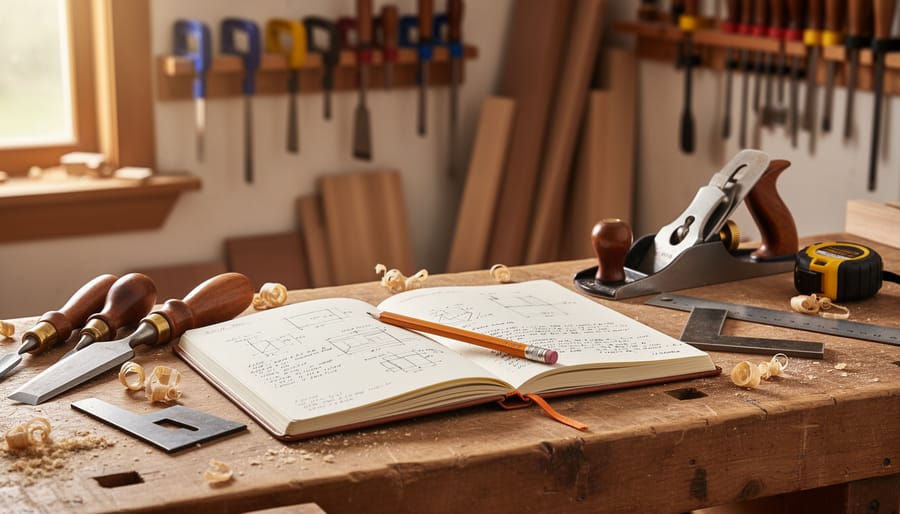
These workshops teach you systems for tracking your woodworking journey in ways regular journaling never addresses. You’ll learn to sketch quick project diagrams, note tool settings that produced perfect results, and document finishing techniques alongside actual wood samples. This becomes your personal reference library, built from real experience rather than generic instructions.
The community aspect makes journal workshops especially valuable. You’re not just writing in isolation; you’re part of a group of fellow woodworkers who share their documentation methods, celebrate each other’s progress, and collectively build a treasure trove of practical knowledge. Someone might share their brilliant system for tracking wood moisture content, while another demonstrates how they photograph projects at different stages.
This collaborative environment turns journaling from a solitary activity into a growth experience that accelerates your transformation from beginner to confident craftsperson. Your journal becomes evidence of skills gained, mistakes learned from, and the beautiful evolution of your woodworking abilities.
Why Woodworkers Who Keep Journals Progress Faster
There’s something almost magical about flipping back through pages of your workshop journal and seeing how far you’ve come. Woodworkers who maintain regular journals consistently progress faster than those who don’t, and the reasons are both practical and profound.
When you document your projects, you create a personal reference library tailored exactly to your learning journey. That tricky mortise and tenon joint that gave you trouble last month? Your notes about what finally worked become your roadmap when you tackle it again. Instead of repeating the same mistakes, you build on previous successes. This is how you truly learn from mistakes rather than just experiencing them.
The act of writing itself deepens your understanding. When you sketch out a joinery detail or describe why your finish came out blotchy, you’re processing the experience at a different level. Your brain makes connections that simply doing the work doesn’t create. Many woodworkers report breakthrough moments happening not at the workbench, but while journaling about their challenges.
Problem-solving becomes exponentially easier when you can track patterns over time. Maybe you notice your measurements are consistently off on humid days, or that your hand-cut dovetails improve dramatically after warming up with practice cuts. These insights emerge from documentation.
Consider Maria, who started journaling her first birdhouse project with shaky sketches and basic observations. Within a year, her journal entries showed refined techniques, confident joinery, and complex furniture designs. Her journal became proof of her transformation from nervous beginner to capable artisan. She could pinpoint exactly when concepts clicked, which techniques needed more practice, and how her problem-solving skills evolved.
Your journal doesn’t judge your early attempts. It celebrates them as stepping stones. Every entry is evidence that you’re not just making sawdust, you’re building expertise, one documented project at a time.
What You’ll Actually Do in a Journal Workshop
Setting Up Your Woodworking Journal System
Starting your woodworking journal is easier than you might think, and there’s no single right way to do it. Let’s explore what works best for you and your creative journey.
First, decide between physical and digital formats. A traditional notebook offers that satisfying tactile experience, perfect for quick sketches and measurements right at your workbench. Digital options like apps or simple word documents make searching past projects effortless and keep everything backed up safely. Many woodworkers find success using both, snapping photos of their notebook pages to create a hybrid system.
What should you include? Start simple with these essentials: project names and dates, wood species and dimensions, step-by-step processes, mistakes and how you solved them, tools and techniques used, and finish details. Don’t forget to track your transformation moments, those breakthrough experiences when a technique suddenly clicks.
Create easy templates that work for your style. A basic project page might have sections for materials list, cutting measurements, assembly notes, and lessons learned. For technique tracking, note what you tried, what worked beautifully, and what you’d adjust next time.
Remember, your journal grows with you. Sarah, one of our community members, started with a simple spiral notebook tracking dovetail practice. Two years later, her detailed journals became the foundation for teaching others. Your entries today document the beginning of your own inspiring transformation story. Keep it genuine, keep it useful, and watch how this practice deepens your woodworking confidence.
Capturing Your Workshop Moments That Matter
Your workshop journal doesn’t need fancy equipment or artistic talent. The beauty lies in capturing what matters to you in ways that feel natural and helpful. Think of it as creating your personal woodworking story, one project at a time.
Start simple with before-and-after photos of your builds. Use your phone to snap quick pictures at different stages, especially when you’re trying a new technique. These visual references become invaluable when you tackle similar projects months later and think, “How did I solve that problem last time?”
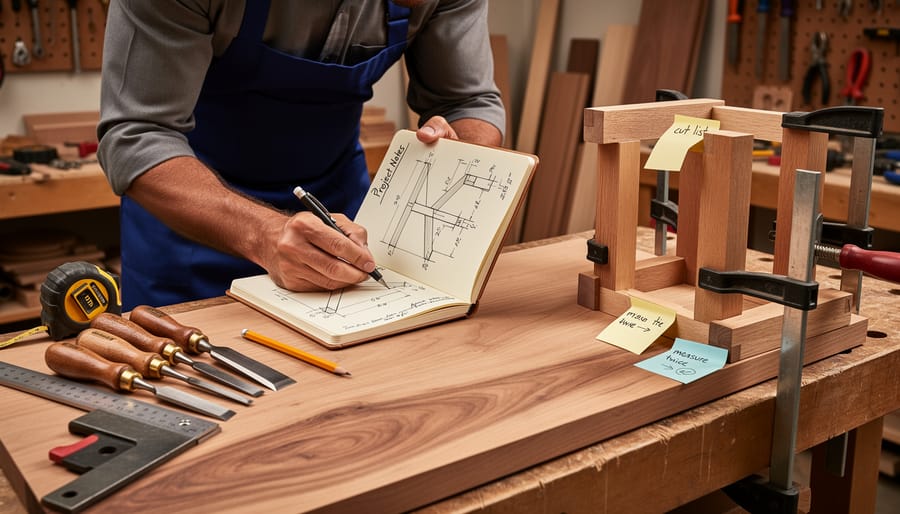
Sketching is wonderfully forgiving in a workshop journal. Quick pencil drawings with measurements and notes work perfectly. You’re not creating museum pieces; you’re capturing ideas that pop into your head while sanding or assembling. Draw that clever jig you improvised or the grain pattern that made you stop and stare. These rough sketches often spark inspiration for future projects.
Keep track of tool settings that worked well. Jot down your table saw height for perfect dovetails or the router speed that gave you a clean edge. These little notes save hours of trial and error next time around.
The most magical moments to capture are your breakthroughs. When something finally clicks, write it down immediately. Maybe you discovered why your cuts were consistently off or figured out a better way to clamp awkward pieces. These “aha” moments represent real growth in your journey from beginner to confident craftsperson.
Use whatever recording method feels easiest. Sticky notes transferred to your journal, voice memos transcribed later, or quick margin notes all work beautifully. The goal is capturing knowledge without interrupting your creative flow, building a resource that grows alongside your skills.
How Journal Workshops Build Community Among Makers
There’s something magical that happens when makers gather to share their journal entries. What starts as individual documentation quickly becomes the foundation for lasting friendships and genuine connections. When you flip through your woodworking journal at a workshop and show another participant the mistake you made on your first dovetail joint, you’re not just sharing a photo—you’re opening a door for honest conversation and mutual growth.
Journal workshops create natural opportunities for experienced woodworkers to guide newcomers without the formality of traditional instruction. Picture this: a seasoned craftsperson notices your sketches for a bookshelf project and offers a simple suggestion about wood movement that saves you from future headaches. These spontaneous mentorship moments happen organically when journals become conversation starters rather than private notebooks tucked away.
The beauty of sharing documented experiences lies in its power to validate everyone’s journey. Beginners discover they’re not alone in their struggles when they see others’ early attempts and progression. Meanwhile, experienced makers get reminded of how far they’ve traveled, which reignites their passion and patience for teaching. Your journal becomes a bridge connecting different skill levels, creating that supportive artisan community where everyone belongs.
These workshops also foster accountability partnerships. When you share your goals with fellow participants, you’re more likely to follow through. Someone might ask at the next gathering, “How did that router table project turn out?” That gentle accountability, wrapped in genuine interest, keeps your momentum going.
The collaborative atmosphere extends beyond the workshop itself. Participants often exchange contact information, forming study groups or shop-sharing arrangements. They celebrate each other’s victories and troubleshoot challenges together. Your journal documentation provides the perfect framework for these ongoing relationships, giving you concrete projects and experiences to discuss and learn from collectively. This transforms what could be a solitary craft into a vibrant, connected practice.

Making Your Journal Workshop Participation Work for You
Getting the most from your journal workshop starts with showing up with an open mind and a willingness to experiment. Don’t worry about making your entries perfect or polished – remember, your workshop journal is a personal space for growth, not a finished project to display. Bring along any questions about your woodworking challenges or creative blocks, because these workshops thrive on shared experiences and collective wisdom.
During the workshop, take advantage of the prompts and exercises offered, even if they feel unfamiliar at first. Many participants discover their best insights come from unexpected directions. Connect with fellow woodworkers in the group – their journeys from beginners to confident craftspeople can inspire your own path forward.
The real magic happens after the workshop ends. Set yourself up for success by scheduling regular journaling time in your calendar, even if it’s just ten minutes twice a week. Keep your journal near your workspace so it becomes a natural part of your creative routine. Consider starting each project by jotting down your intentions and ending with reflections on what you learned.
Stay connected with your workshop community through follow-up meetups or online groups. Share your progress, celebrate small victories, and support others through their challenges. This ongoing connection transforms a single workshop experience into a lasting habit that fuels your growth as a woodworker. Your journal becomes more than pages – it becomes a trusted companion documenting your transformation from wherever you started to wherever you’re headed next.
Ready to transform your woodworking journey? Embracing a journal workshop isn’t just about documenting projects—it’s about celebrating every cut, every grain pattern discovered, and every lesson learned along the way. Your journal becomes a personal testament to your growth, a roadmap showing how far you’ve traveled from that first nervous saw cut to confident craftsmanship. We invite you to join the Wood & Work community, where makers share their stories, support each other’s progress, and inspire continuous learning. Start your journal today, capture your creative process, and become part of a transformation story that proves anyone can master this timeless craft. Your journey from beginner to skilled artisan begins with a single page.